SWP Mistakes to Avoid: Systematic Withdrawal Plans (SWPs) are often promoted as the smartest way to generate regular income from mutual funds, especially during retirement or after achieving a major financial goal. On paper, SWP looks perfect: disciplined withdrawals, tax efficiency, flexibility, and continued market participation. But in real life, many investors unknowingly make critical errors that slowly erode their capital, reduce income stability, and create unnecessary financial stress.
As a mutual fund and SWP-focused finance expert, I have seen one recurring pattern. SWP itself is not flawed, but the way investors implement it often is. This is why understanding SWP mistakes is far more important than simply asking whether SWP is profitable or not.
In this detailed guide, we will break down the 5 most common SWP mistakes to avoid while investing in mutual funds, explain why SWP sometimes feels bad for investors, highlight the real risks in SWP, and show how to design a withdrawal strategy that actually works long term.
Also Check: Is SWP Taxable in India
What Is an SWP and Why Investors Choose It?
Before diving into mistakes, let’s quickly align on the concept. A Systematic Withdrawal Plan allows investors to withdraw a fixed amount at regular intervals (monthly, quarterly, or annually) from their mutual fund investments. SWP is commonly used by retirees, passive income seekers, and investors who have completed their SIP phase.
Key reasons investors prefer SWP:
- Regular cash flow without liquidating the entire investment
- Better tax efficiency compared to fixed income products
- Potential for capital appreciation even during withdrawals
- Flexibility to modify or stop withdrawals anytime
However, these benefits only materialize when SWP is structured correctly.
Mistake 1: Choosing the Wrong Mutual Fund for SWP
Why This Is One of the Biggest SWP Mistakes
One of the most common SWP mistakes is assuming that any mutual fund is suitable for withdrawals. Many investors start SWP from high-risk equity funds or ultra-low-return debt funds without aligning the fund’s nature with their income needs.
What Goes Wrong
- Equity-heavy funds can face volatility during market downturns
- Aggressive funds may force unit depletion during bear markets
- Low-yield funds may not support regular withdrawals at all
This leads investors to believe that SWP is bad, when the real problem is poor fund selection.
How to Avoid This Mistake
- Use hybrid funds or conservative equity funds for stability
- Align fund volatility with withdrawal dependency
- Avoid starting SWP from newly invested equity funds
Mistake 2: Withdrawing Too Much, Too Soon
The Silent Capital Killer
Many investors treat SWP like a guaranteed income product. They calculate monthly expenses and start withdrawing aggressively without assessing whether the portfolio can sustain it.
What Are the Risks in SWP Here?
- Capital erosion during market corrections
- Faster depletion of units
- Reduced long-term income sustainability
This mistake often leads to the question: why SWP is bad, when in reality the withdrawal rate is unrealistic.
Expert Rule of Thumb
- Annual withdrawal should ideally remain between 3% to 5% of corpus
- Higher withdrawals may work temporarily but fail long term
- Inflation-adjusted withdrawals need careful planning
Mistake 3: Ignoring Market Cycles and Timing
SWP Is Not Set-and-Forget
Another major SWP mistake is assuming that market conditions do not matter once SWP starts. Investors often continue fixed withdrawals even during prolonged market downturns.
What Happens During Bear Markets
- NAV falls but withdrawals continue
- More units are redeemed to generate the same income
- Portfolio recovery becomes difficult
This creates a negative compounding effect, especially for retirees relying solely on SWP.
Smarter SWP Strategy
- Maintain a buffer fund for 12 to 24 months
- Reduce withdrawals temporarily during severe market corrections
- Use a dynamic SWP approach instead of fixed withdrawals
Mistake 4: Poor Tax Planning in SWP
SWP Is Tax-Efficient, But Not Tax-Free
Many investors misunderstand SWP taxation and assume that all withdrawals are either fully taxable or fully tax-free. Both assumptions are incorrect.
Common Tax-Related SWP Mistakes
- Not considering capital gains holding periods
- Ignoring indexation benefits in debt funds
- Overlooking tax implications during fund switching
This confusion leads investors to question: is SWP profitable, when poor tax planning eats into net returns.
Tax Optimization Tips
- Prefer equity funds for long-term SWP due to lower LTCG tax
- Stagger withdrawals to reduce annual tax burden
- Avoid frequent switching during SWP phase
Mistake 5: No Inflation Adjustment in Withdrawal Planning
Fixed Income in a Rising Cost World
One of the most dangerous SWP mistakes is withdrawing a fixed amount for years without accounting for inflation. What feels sufficient today may become inadequate after 5 to 10 years.
Long-Term Impact
- Declining purchasing power
- Increased dependency on corpus
- Higher stress during later years
This is especially risky for retirees who depend on SWP as their primary income source.
Inflation-Smart SWP Planning
- Gradually increase withdrawal amounts
- Choose funds with growth potential
- Reassess SWP every 2 to 3 years
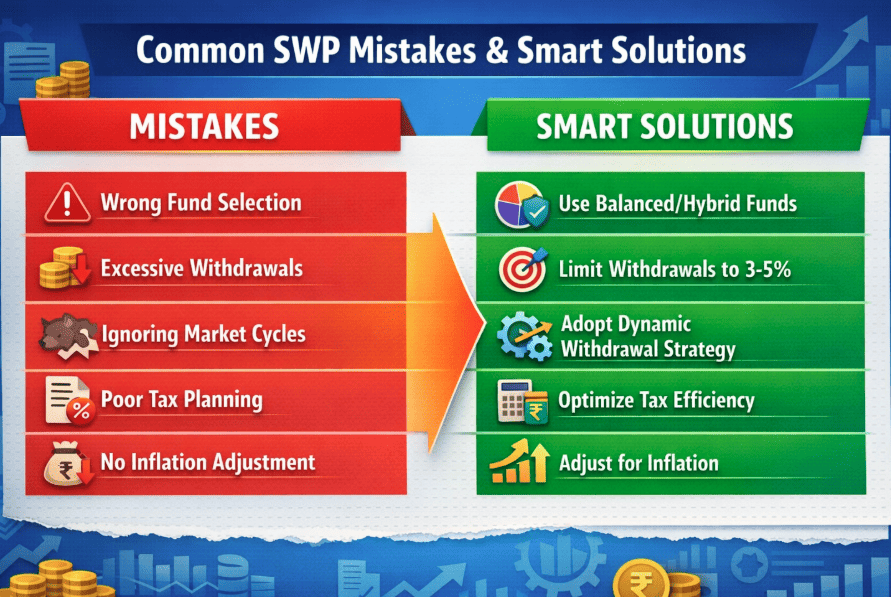
Summary of Common SWP Mistakes and Solutions
| Common SWP Mistake | Why It Happens | Risk Created | Smart Solution |
| Wrong fund selection | Chasing returns | Volatility risk | Use balanced or hybrid funds |
| Excessive withdrawals | Expense pressure | Capital erosion | Limit to sustainable rates |
| Ignoring market cycles | Passive mindset | Unit depletion | Dynamic withdrawal strategy |
| Poor tax planning | Lack of awareness | Lower net returns | Optimize holding periods |
| No inflation planning | Short-term thinking | Reduced purchasing power | Periodic review and adjustment |
Is SWP Profitable or Is SWP Bad?
SWP is neither inherently profitable nor bad. Its success depends entirely on how it is structured. When done correctly, SWP can generate tax-efficient income while preserving capital. When done incorrectly, it can destroy wealth silently.
The real risks in SWP come from:
- Overconfidence
- Poor planning
- Lack of periodic review
Understanding and avoiding these SWP mistakes is the difference between sustainable income and financial regret.
FAQs on SWP Mistakes to Avoid
1. What are some common SWP mistakes investors make?
- Common SWP mistakes include choosing the wrong fund, withdrawing too aggressively, ignoring market cycles, poor tax planning, and failing to adjust for inflation.
2. Is SWP profitable for long-term investors?
- SWP can be profitable when withdrawals are sustainable, funds are chosen wisely, and market risks are managed properly. Profitability depends on strategy, not the product itself.
3. Why do some people say SWP is bad?
- SWP feels bad when investors experience capital erosion or unstable income. This usually happens due to incorrect withdrawal rates or poor fund selection, not because SWP is flawed.
4. What are the risks in SWP?
- Key risks in SWP include market volatility, unit depletion, inflation risk, and tax inefficiency if not planned correctly.
5. Can SWP be modified after starting?
- Yes, SWP is flexible. Investors can change withdrawal amounts, pause SWP, or stop it entirely based on financial needs and market conditions.
Final Words:
Systematic Withdrawal Plans are powerful tools when used with discipline, patience, and strategy. Unfortunately, most investors focus only on monthly income and ignore the long-term mechanics that sustain it.
The five SWP mistakes discussed above are not rare errors; they are extremely common and often go unnoticed until real damage is done. Choosing the wrong fund, withdrawing excessively, ignoring market cycles, mishandling taxes, and neglecting inflation can quietly drain your portfolio while giving the illusion of stability. SWP is not bad, and it is certainly not a guaranteed income scheme either. It is a dynamic financial strategy that requires periodic review, realistic expectations, and expert-level planning.
When designed correctly, SWP can deliver steady income, tax efficiency, and capital longevity even in volatile markets. The key takeaway is simple: avoid these SWP mistakes, align withdrawals with market realities, and treat SWP as a living strategy rather than a one-time setup. That is how investors turn SWP into a reliable income engine instead of a silent wealth destroyer.
I hope the above guide will help you to avoid common SWP mistakes so you can get more profit on mutual funds easily. If you still have any question on mutual funds please feel free to ask in the below comment section. Follow for more investment tips for thanks for your visit.
Tags: What are some common SWP mistakes? is swp profitable, why swp is bad, What are the risks in SWP? What are the disadvantages of SWP? Is there any chance of loss in SWP? Swp mistake in mutual fund.