SWP Strategy for 50k Monthly Income: Hey friend, Can ₹50 lakh truly give you ₹50,000 every month forever? At first glance, the math seems simple. If mutual funds can deliver 12% average annual returns, and you withdraw 12% a year, you should be fine… right?
That’s where most investors get it dangerously wrong. It’s not the average return that determines whether your SWP (Systematic Withdrawal Plan) will last a lifetime it’s the sequence of returns that decides your fate.
If the market crashes right after you start withdrawing, your corpus may shrink beyond recovery. But if the good years come first, your portfolio could outlive you. That’s why understanding the Smart SWP Strategy is not optional it’s the difference between lifelong income and running out of money in your 60s.
In this guide, we’ll decode exactly how to build a Smart SWP Strategy one that protects your income, balances risk, and turns a ₹50 lakh investment into a sustainable, inflation-beating monthly payout. Okay, let’s get into the topic below.

What is SWP (Systematic Withdrawal Plan)?
An SWP, or Systematic Withdrawal Plan, allows you to withdraw a fixed amount regularly from your mutual fund investment monthly, quarterly, or annually. Think of it as the reverse of an SIP. While SIP helps you accumulate wealth, SWP helps you generate regular income.
SWP vs SIP
| Feature | SIP (Systematic Investment Plan) | SWP (Systematic Withdrawal Plan) |
| Flow Direction | Inflow (investing money) | Outflow (withdrawing money) |
| Objective | Wealth creation | Income generation |
| Ideal For | Salaried investors | Retirees / Freelancers / Passive income seekers |
| Taxation | Gains taxed on redemption | Gains taxed on withdrawal |
An SWP is popular among retirees who want predictable monthly income without relying on volatile dividends or selling lump sums.
Why Turning ₹50 Lakh into ₹50000 per Month Is a Tricky Equation?
Most investors assume that if the market averages 12% a year, withdrawing 12% should be sustainable. But average returns lie markets don’t move in straight lines.
This is where the sequence of returns comes in. The order in which you experience gains and losses determines how long your corpus lasts.
Imagine two retirees. Both invest ₹50 lakh, both get the same long-term average return. But one faces a market crash in the first year, the other enjoys a rally. After 10 years, their outcomes are night and day.
This is called sequence risk the silent killer of financial freedom.
The Three Market Scenarios- Timing Can Change Everything
Scenario 1: The Crash Comes First (Bad Sequence)
Let’s take real market data from 2011–2013. Suppose you start your SWP with ₹50 lakh and withdraw ₹50,000 monthly (₹6 lakh annually).
- Year 1: Market crashes 24% (like 2011). Your corpus drops to ₹38 lakh.
- After withdrawal, you start Year 2 with ₹32 lakh.
- Year 2: Market rebounds 28% (2012). Corpus grows to ₹40 lakh.
- Year 3: Muted 7% gain (2013), ending around ₹37 lakh.
Even if you assume steady 12% returns thereafter, your portfolio runs out of money in just 13 years. The reason? You started withdrawals when the market was bleeding.
Scenario 2: The Boom Comes First (Good Sequence)
Now flip the script. You begin your SWP during a strong market year like 2020.
- Year 1: +15% gain → corpus grows to ₹57.5 lakh.
- Year 2: +24% rally → corpus jumps to ₹64 lakh.
- Year 3: +4% modest return → corpus stays near ₹60 lakh.
From Year 4 onward, even with 12% steady returns, your ₹50 lakh corpus continues to grow despite withdrawals. The early growth acts as a buffer that keeps compounding over time.
Scenario 3: The 2008-Style Meltdown (Nightmare Case)
This is the doomsday scenario. In 2008, the Nifty fell 51% in a year. If that happens right after you start withdrawing, your ₹50 lakh becomes ₹24.5 lakh before even taking out ₹6 lakh for expenses.
Even if the market rebounds 75% next year, your portfolio struggles to recover. You start from a smaller base, and withdrawals accelerate the decline. Your money could vanish in less than 10 years.
Lesson: The Smart SWP Strategy isn’t about chasing returns it’s about surviving market sequences.
The Core Lesson- Smart SWP Strategy Is About Survival, Not Just Returns
A Smart SWP Strategy focuses on sustainability ensuring your money lasts through both bull and bear markets.
This brings us to the concept of the Safe Withdrawal Rate (SWR).
What is the Safe Withdrawal Rate?
The Trinity Study (a landmark US research paper) analyzed 75 years of market data and found that a portfolio with 50–75% equity, withdrawing 4% annually, had a 95% chance of lasting 30+ years even through recessions and crashes.
In Indian terms:
- A ₹1 crore portfolio → ₹4 lakh per year (₹33,000/month) is considered sustainable.
- A ₹50 lakh portfolio → ₹2 lakh per year (₹17,000/month) is safer.
Withdrawing ₹6 lakh per year (12%) from ₹50 lakh, however, is financial suicide your corpus will burn out quickly. To understand the impact of different return rates and withdrawal frequencies, you can explore our Smart SWP Calculator.
Building Your Smart SWP Strategy (Step-by-Step Guide)
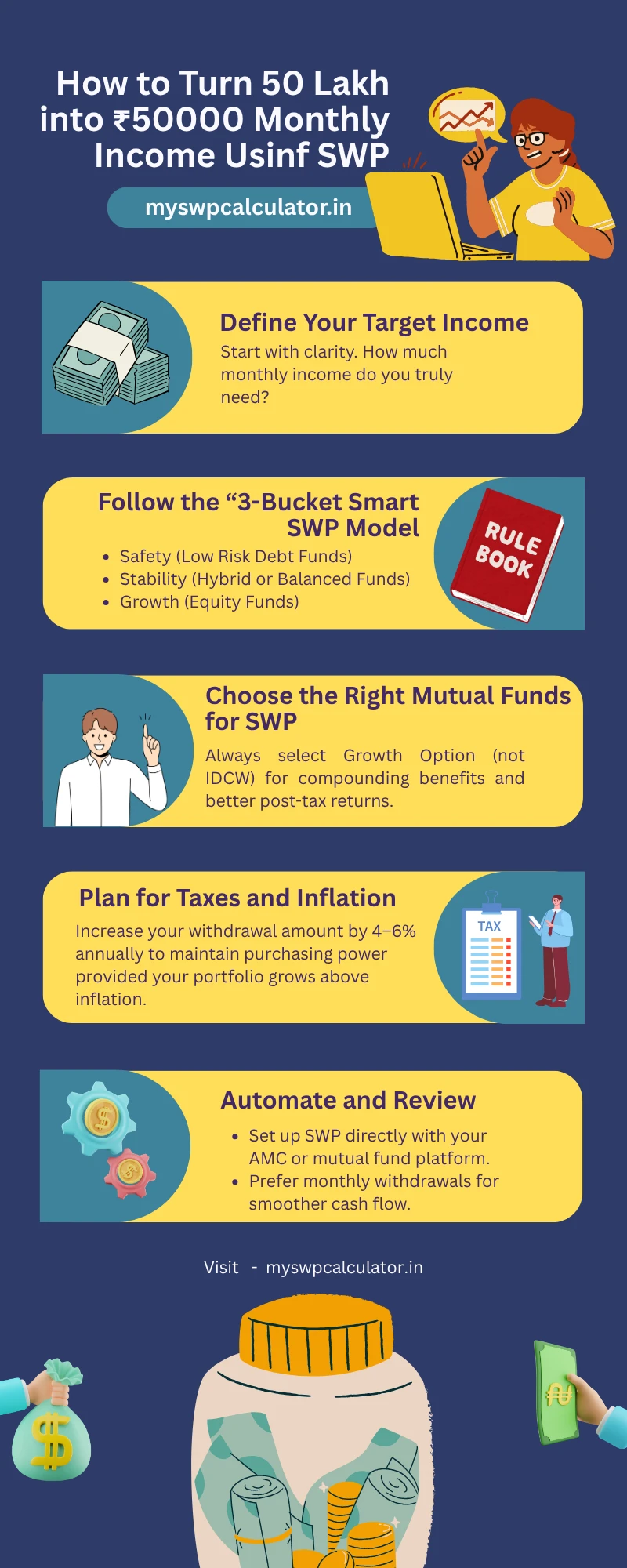
Step 1: Define Your Target Income
Start with clarity. How much monthly income do you truly need?
For example, ₹50,000/month = ₹6 lakh/year. That’s a 12% withdrawal rate on ₹50 lakh unsustainable over long periods.
A safer range is 4%–5%.
| Monthly Income | Annual Income | Safe Withdrawal Rate | Required Corpus |
| ₹25,000 | ₹3,00,000 | 5% | ₹60 lakh |
| ₹50,000 | ₹6,00,000 | 4% | ₹1.5 crore |
| ₹75,000 | ₹9,00,000 | 4% | ₹2.25 crore |
Insight: To safely earn ₹50,000 per month for decades, you’d need a corpus closer to ₹1.5 crore, not ₹50 lakh.
Step 2: Follow the “3-Bucket Smart SWP Model”
This approach divides your corpus based on time horizon and risk.
1. Bucket 1: Safety (Low Risk Debt Funds)
- Holds 2–3 years of expenses.
- Ideal for liquid funds, ultra-short debt funds.
- Protects your income during market crashes.
2. Bucket 2: Stability (Hybrid or Balanced Funds)
- 30–40% of corpus.
- Generates moderate growth with lower volatility.
3. Bucket 3: Growth (Equity Funds)
- Long-term engine for wealth creation.
- Large-cap, flexi-cap, or index funds.
By rebalancing yearly, you refill your Safety Bucket from growth profits. This shields your withdrawals from short-term market shocks.
Step 3: Choose the Right Mutual Funds for SWP
- Equity Funds: Nifty Index, Large-Cap, Flexi-Cap funds.
- Hybrid Funds: Dynamic Asset Allocation or Balanced Advantage funds.
- Debt Funds: Liquid, Ultra-Short Duration, or Corporate Bond funds.
Tip: Always select Growth Option (not IDCW) for compounding benefits and better post-tax returns.
Step 4: Plan for Taxes and Inflation
- Equity SWP Tax: Long-term (after 1 year) taxed at 10% on gains above ₹1 lakh.
- Debt SWP Tax: Taxed as per income slab after 3 years of indexation benefit.
- Inflation Impact: ₹50,000 today will equal only ₹25,000 in 12 years at 6% inflation.
Smart Tip: Increase your withdrawal amount by 4–6% annually to maintain purchasing power provided your portfolio grows above inflation.
Step 5: Automate and Review
- Set up SWP directly with your AMC or mutual fund platform.
- Prefer monthly withdrawals for smoother cash flow.
- Review every 6–12 months to rebalance and adjust withdrawal rates.
- Use reliable SWP calculators to project how long your corpus will last.
These are the step to turn your 50 lakhs swp mutual funds investment into a 50000 monthly income easily. Before start investing on SWP avoid the below common mistakes.
Common Mistakes Investors Make with SWP
- Withdrawing too much too soon: Anything above 6–7% annual withdrawal rate is risky.
- Ignoring market sequence risk: Starting withdrawals during a crash can destroy long-term sustainability.
- No diversification: Depending only on equity funds increases volatility.
- No rebalancing: Failing to refill your safety bucket means selling equity during downturns.
- Treating SWP like an FD: SWP returns are market-linked, not guaranteed.
Once you start avoiding the above listed common mistakes then you can easily make money from your swp funds. Checkout the top 5 best SWP funds in india.
FAQs on Smart SWP Strategy
1. Can I start SWP from my existing SIP corpus?
- Yes. Once your SIP builds a corpus, you can switch those units to Growth Option funds and activate SWP to generate regular income.
2. Is SWP better than dividend payout options?
- Absolutely, Dividends depend on fund house discretion, while SWP gives you control over how much and when you withdraw.
3. What happens if the market crashes during my SWP?
- If you’ve followed the 3-Bucket Smart SWP Strategy, your near-term income comes from safe assets, giving equity time to recover.
4. How long should I stay invested before starting SWP?
- Ideally, accumulate for at least 3–5 years before beginning withdrawals. It reduces sequence risk.
5. What’s the best mutual fund type for SWP in India?
- Balanced Advantage or Large-Cap Equity Funds with growth option are preferred for steady performance and long-term compounding.
Final Words:
The biggest misconception in personal finance is that earning 12% annually guarantees financial freedom. In reality, the Smart SWP Strategy teaches you that survival matters more than returns.
A ₹50 lakh portfolio can give you ₹50,000 monthly but only temporarily if luck runs against you. The moment a crash hits early, your plan could crumble. Yet, with smart design diversified buckets, disciplined withdrawal rates, inflation adjustments, and periodic rebalancing your income can last for life.
Remember, the market’s behavior is beyond your control, but your strategy isn’t. Focus on sustainability, not short-term excitement. A truly smart investor doesn’t chase 12% returns they chase consistency.
In the end, financial independence is not about how much you earn, but how intelligently you withdraw. Your corpus doesn’t create freedom your Smart SWP Strategy does. Follow this site for more latest swp related tips and strategies. If you have any doubts on swp mutual funds please feel free to contact us or leave your doubts on the below comment section. We are always ready to give you the best solutions as soon as possible. Thanks for your visit.
Tags: 50 lakh swp plan, Which is the best SWP scheme? How to use SWP effectively? Top 5 SWP Mutual funds, Best SWP for retired person, Best SWP for monthly income, What is the best way to invest 50 lakhs?