SIP + SWP Early Retirement Case Study: Hello my dear readers, I have created this post to help youngsters who are planning early retirement using mutual fund investments. Early retirement stories often sound inspiring but vague. You hear phrases like “invest early” or “let compounding work,” but rarely see the real mechanics. This case study breaks that pattern. It shows how SIP + SWP Early Retirement Strategy works in practice, not as a motivational idea but as a financial system.
This is a realistic Indian scenario, built using assumptions discussed by mutual fund experts, retirement planners, and real investor discussions. The goal is simple: retire in your 30s without running out of money. Okay just go through the complete case study and learn your best way to invest in both SIP and SWP to make regular montly income without any job in your late 30s. Okay, let’s get into the topic below.

Also Check: SWP Strategy To Make 1 Lakh Monthly Income
Profile of the Investor
Let’s call him Arjun.
- Age when planning started: 26
- Profession: IT professional
- Monthly income at start: ₹75,000
- Monthly income at peak (age 32): ₹1.6 lakh
- Lifestyle: Upper-middle class, no luxury debt
- Goal: Financial independence before 40
Arjun did not inherit money. His edge was clarity and consistency, not luck.
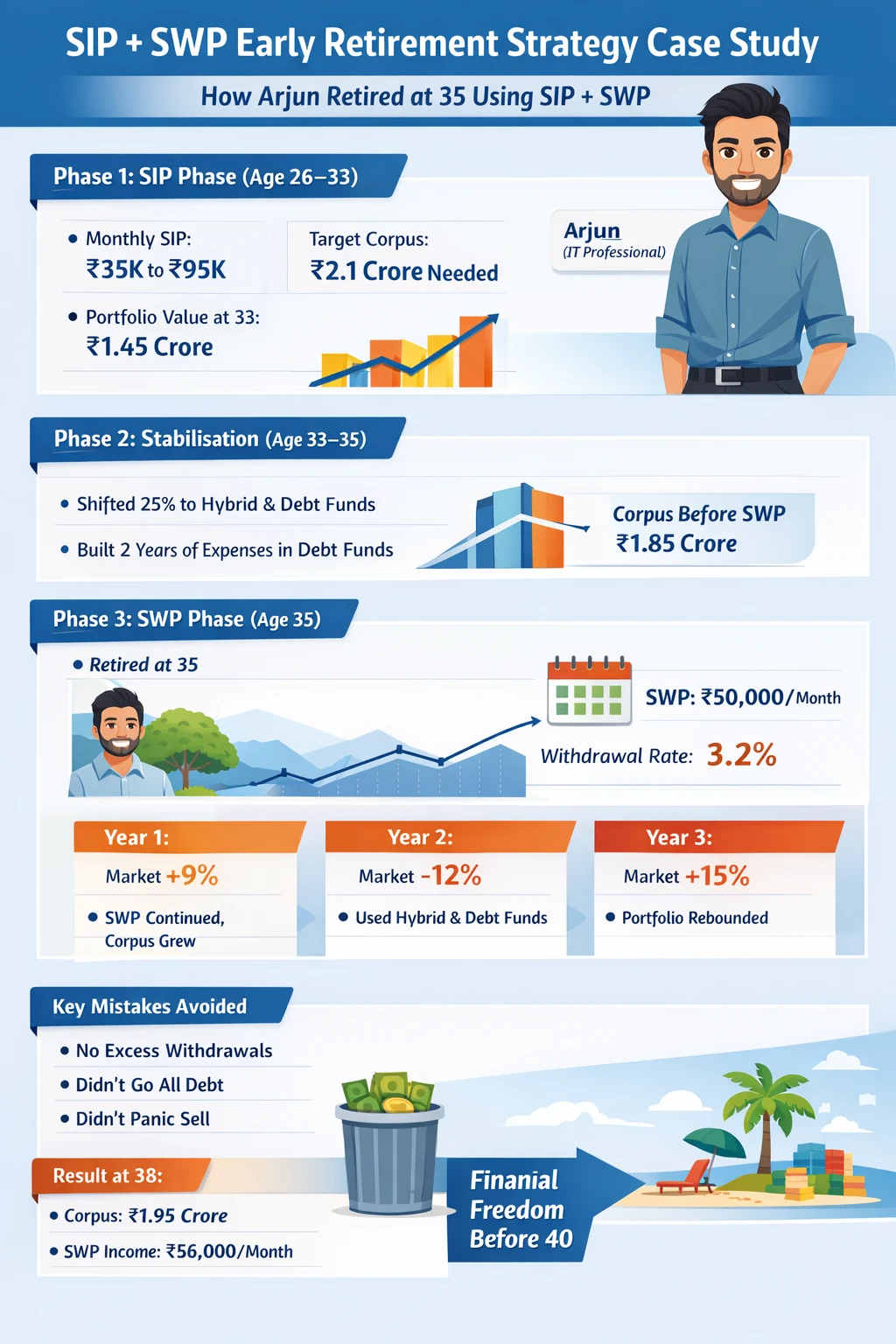
Phase 1: SIP Phase (Age 26 to 33)
Arjun’s strategy was not to invest what was left after expenses. He reversed the formula.
SIP Planning Logic
Instead of asking “how much can I invest?”, he asked: “How much do I need to retire early, and what SIP will get me there?”
His target corpus for early retirement:
- Annual expenses (at 35): ₹7.5 lakh
- Safe withdrawal rate: 3.5%
- Required corpus ≈ ₹2.1 crore
This number guided everything.
SIP Execution Over 7 Years
Arjun increased SIPs as income rose.
| Age | Monthly SIP | Annual SIP |
| 26 | ₹35,000 | ₹4.2 lakh |
| 28 | ₹50,000 | ₹6 lakh |
| 30 | ₹70,000 | ₹8.4 lakh |
| 32 | ₹95,000 | ₹11.4 lakh |
Average SIP over 7 years ≈ ₹62,000
Funds chosen:
- Large-cap index fund
- Flexi-cap fund
- Mid-cap fund
Expected return: ~12%
Corpus Built by Age 33
- Total invested: ~₹52 lakh
- Portfolio value at 33: ~₹1.45 crore
This is where most people make a mistake. They assume they are “done.” Arjun did not.
Phase 2: Pre-Retirement Stabilisation (Age 33 to 35)
This phase is important and often skipped. Arjun did not quit his job immediately. Instead, he focused on risk reduction without killing growth.
Changes Made
- Stopped aggressive mid-cap exposure
- Shifted 25% of corpus into hybrid funds
- Built 2 years of expenses in low-volatility debt funds
- Continued SIPs at ₹40,000 (lower than before)
By age 35:
- Total corpus: ~₹1.85 crore
- Equity exposure reduced from 85% to ~62%
This phase protects against sequence of returns risk, the biggest enemy of early retirees.
Phase 3: SWP Phase Begins (Age 35)
At 35, Arjun resigned. Not because he was “rich”, but because his cash flow was now independent of employment.
SWP Structure Used
- Monthly SWP amount: ₹50,000
- Annual withdrawal: ₹6 lakh
- Withdrawal rate: ~3.2%
To make this practical, you can use an SWP calculator to test different SIP amounts, withdrawal rates, and timelines to see how long your retirement corpus can realistically sustain monthly income.
SWP was split across:
- Hybrid fund SWP for stability
- Equity fund SWP for long-term growth
This structure ensured:
- Predictable monthly income
- Minimal NAV shock
- Tax-efficient withdrawals
What Happened in the First 3 Years of SWP
This is where theory meets reality.
Year 1 (Normal Market)
- Portfolio growth: ~9%
- SWP withdrawals: ₹6 lakh
- End-of-year corpus: ₹1.92 crore
Despite withdrawals, the corpus grew.
Year 2 (Market Correction)
- Market fell ~12%
- SWP continued without panic
- Withdrawals funded mainly from debt and hybrid funds
End-of-year corpus: ~₹1.78 crore
This is where unplanned retirees fail. Arjun didn’t sell equity at the bottom.
Year 3 (Market Recovery)
- Equity rebound: ~15%
- Corpus bounced back to ~₹1.95 crore
This is the core proof of SIP + SWP Early Retirement Strategy. The system absorbed volatility without lifestyle disruption.
Inflation Handling in Real Life
Arjun increased SWP by 6% every year.
- Year 1: ₹50,000/month
- Year 3: ~₹56,000/month
- Year 5 projection: ~₹63,000/month
This adjustment was possible because:
- Equity portion kept compounding
- Withdrawal rate stayed under control
How This Case Answers Common Questions?
1. Is 30 too late to save for retirement?
- Arjun started at 26 and retired at 35. Starting at 30 would still give a 10–12 year runway.
2. How much should I have saved at 33?
- Arjun had ~₹1.45 crore at 33. More important than the number was expense alignment.
3. What is the right age to start SWP?
- Arjun started SWP at 35 because the corpus was ready, not because of age.
Applying the 70/30 Rule Buffett-Style
Arjun followed a modified 70/30 rule:
- 70% growth-oriented assets
- 30% stability-oriented assets
This prevented emotional decisions during downturns and protected income continuity.
Biggest Mistakes Arjun Avoided
Most early retirement failures come from these errors. Arjun avoided all of them.
- He did not withdraw more than 4%
- He did not park everything in debt
- He did not stop tracking his portfolio
- He did not ignore healthcare costs
- He did not assume SWP is “guaranteed income”
How This Case Differs From Traditional Retirement Planning?
Traditional retirement assumes:
- Work till 60
- Corpus is touched only after retirement
- Growth stops after retirement
This SIP + SWP case proves:
- Growth continues after retirement
- Income is flexible, not fixed
- Retirement is a financial state, not an age.
Key Takeaways from This SIP + SWP Early Retirement Strategy Case Study
- Early retirement requires system design, not motivation
- SIP builds the engine, SWP controls the output
- Asset allocation matters more than fund selection
- Withdrawal discipline decides success
- Market volatility is survivable with planning
Tax Efficiency of SIP + SWP Strategy
One of the biggest advantages of SWP over dividends or FD income is taxation.
-
Only the capital gains portion of each withdrawal is taxed
-
Equity LTCG up to ₹1.25 lakh is tax-free
-
Short-term volatility does not impact tax efficiency significantly
This makes SWP far more efficient than traditional retirement income methods.
Understanding SIP for Early Retirement
Why SIP Is Critical in Your 20s and Early 30s
SIP helps you:
- Build discipline
- Average market volatility
- Benefit from compounding
- Invest without timing the market
For early retirement, SIP amounts are usually higher than traditional retirement planning.
How to Make 1 Cr in 5 Years With SIP
Making ₹1 crore in 5 years through SIP is aggressive but possible with:
- High monthly SIP (₹1–1.2 lakh)
- Equity-oriented funds
- Market returns of 12–14%
Example:
- Monthly SIP: ₹1,10,000
- Time: 5 years
- Expected return: ~13%
- Approx corpus: ₹1 crore
This works best for high-income professionals and dual-income families.
SIP SWP Early Retirement Strategy Example
Let’s look at a simplified real-world example.
Accumulation Phase (Age 25–35)
- Monthly SIP: ₹75,000
- Duration: 10 years
- Expected return: 12%
- Corpus built: ~₹1.7 crore
Withdrawal Phase (Age 35 onwards)
- Monthly SWP: ₹50,000
- Annual withdrawal: ₹6 lakh
- Withdrawal rate: ~3.5%
If the portfolio grows at 8–10% post-retirement, the corpus can last 35–40 years with inflation-adjusted withdrawals. This is the core logic behind the best SIP SWP early retirement strategy.
FAQs on SWP Early Retirement Strategy
1. Is SWP safe for early retirement?
- Yes, if withdrawal rates are controlled and asset allocation is balanced.
2. Can I restart SIP after starting SWP?
- Yes, Many early retirees continue small SIPs to counter inflation.
3. What happens during market crashes?
- A well-planned SWP uses debt buffers and rebalancing to avoid selling equity at lows.
4. Should I rely only on mutual funds?
- No, Having side income, rental income, or consulting income improves sustainability.
5. Can this strategy fail?
- It can fail if withdrawals are too high, expenses are uncontrolled, or investments are mismanaged.
Conclusion
This case study proves that the SIP + SWP Early Retirement Strategy is not theory, not social media hype, and not a one-in-a-million success story. It is a repeatable financial framework when applied with discipline, patience, and realism. The most powerful lesson here is not the corpus size but the structure.
SIP creates momentum, stabilisation protects timing risk, and SWP converts wealth into income without destroying the base. Early retirement in your 30s does not mean stopping work forever; it means removing financial compulsion from your life. When income becomes optional, time becomes abundant. That is the real return on SIP + SWP.
I hope the above case stude and guide will helps you to choose the best unvestment plan for your early retirements. If you still have any questions on the SWP and SIP mutual funds please feel free to ask in the below comment section or you can directly contact us. Thanks for your visit follow for more finance tips.
Tags: Sip swp early retirement strategy sbi, Best sip swp early retirement strategy, Is 30 too late to save for retirement? How much should I have saved at 33? What is the right age to start SWP? What is the 70/30 rule buffett? How to make 1 cr in 5 years with SIP? What are the biggest retirement mistakes?